

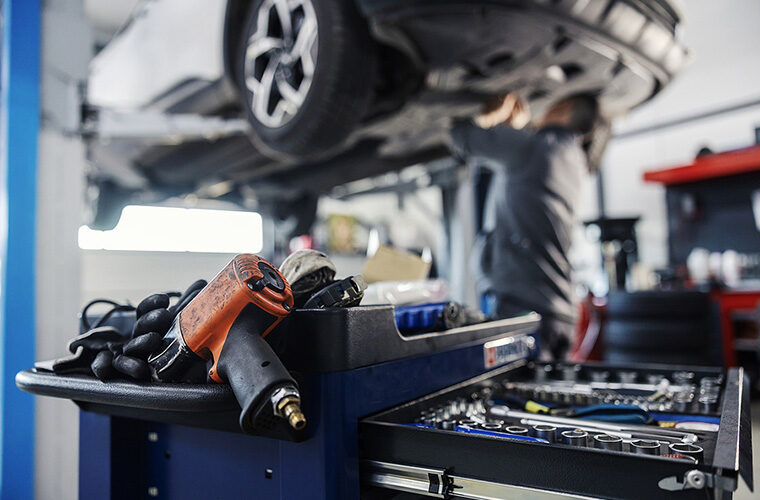
We recently sat down with Robert Adams, Automotive Assessor at Telford College, to find out the latest insights into how the college successfully recruits, trains, and retains automotive apprentices amongst the ongoing skills gap within the aftermarket.
Garage Wire (GW): I believe AutoTech Academy mentioned that they are seeing more women take up these roles. Is that something you are seeing currently?
Robert Adams (RA): Yes. In my pipeline for apprentices this year, I have four female candidates. Some are coming out of full-time courses at the college looking to gain practical experience, while others are school-leavers looking to enter a new industry.
GW: Are you seeing those numbers grow compared to last year?
RA: I am seeing growth. While I have had Level 3 apprentices go through to become qualified light vehicle technicians, my philosophy is that everyone has the right to achieve. I aim to support anyone who shows interest, including students with Education, Health and Care Plans (EHCPs). There is no reason they cannot perform the job, find their niche, and feel their work is worthwhile.
GW: Regarding the industry skill shortage, are you seeing stable numbers, or is interest in automotive technician work increasing or decreasing?
RA: Interest is abundant. When I started this role two and a half years ago, many people told me garages were not employing, but I have found that to be largely misinformation or naivety. I am seeing more companies, including major firms—we have recently placed an apprentice with Kia—realise that their technician workforce is nearing retirement with no succession plan. There is still a critical need to pass on traditional knowledge, such as carburetion, because if those skills are lost, older vehicles become significantly harder to maintain. Apprenticeships provide a solid foundation that allows learners to build a long-term career in various niches within the trade.
GW: You mentioned placing an apprentice with Kia. Are you seeing more main dealers looking for apprentices, or are they building their own schemes?
RA: Some main dealers look to us to help fill shortfalls. We work with Level 3 full-time students who gain work experience at local garages, giving employers a chance to recruit top talent. We aim to strengthen these links with main dealers alongside our business team to provide informed decisions for employers. For example, we work with a local Stellantis-based dealership that invests heavily in their apprenticeship programme and prefers local training over block release to ensure apprentices remain close to home and maintain their support networks.
GW: Do you believe there should be more government emphasis on apprenticeships compared to university education?
RA: The government is pushing apprenticeships as a solution for NEET (Not in Education, Employment, or Training) individuals. However, I believe the government needs to provide more support for businesses. With current apprentice wages, the financial burden on smaller garages can detract from the training experience as employers focus on immediate productivity rather than development. It is a vicious cycle where excessive pressure on apprentices leads to mistakes, but when companies invest the time to train correctly, the returns are significant.
GW: You mentioned a 40-year-old apprentice. Are you seeing more people re-skilling, or is that an outlier?
RA: There is a wide range of ages in the programme. We are actively marketing our Level 3 apprenticeship to experienced, mature tradespeople who may lack formal qualifications in areas like electric vehicles (EV), hydrogen systems, or Advanced Driver Assistance Systems (ADAS). By utilising Recognition of Prior Learning (RPL), we can help them achieve qualifications faster. I believe the trade is becoming increasingly qualification-driven, which will eventually improve safety standards and help regulate independent garages. Having mature students also benefits the peer group, as they often act as informal mentors.
GW: Are you attempting to reposition the industry as more technology-based?
RA: Yes, absolutely. We still need technicians who are comfortable with mechanical work, but we are also training highly skilled diagnosticians. There is a specific need for more auto-electricians, yet there is currently a lack of dedicated courses to support that niche. Regarding retention, some employers are implementing agreements where apprentices must repay training costs on a sliding scale if they leave the business within two years. However, I believe loyalty is a two-way street; for companies to retain their technicians, they need to foster a culture where they truly support their staff.